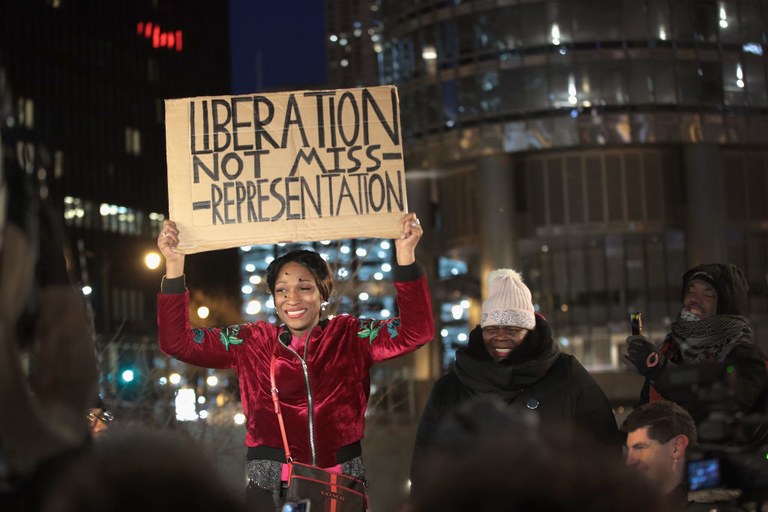
"We must remember that REPRESENTATION and REVOLUTION are not at all the same thing !"
In the spring of 2014, Time magazine put the ever-regal Laverne Cox on its cover and declared that the world had reached a “transgender tipping point.” I have always loved that photograph. Staring out at us all in her blue dress and heels, head raised high, Cox appears to be delivering a challenge to the world. Are you ready for us? her eyes seem to ask. Are you ready to celebrate us – and all of the gifts we have to give?
In the spring of 2014, Time magazine put the ever-regal Laverne Cox on its cover and declared that the world had reached a “transgender tipping point.” I have always loved that photograph. Staring out at us all in her blue dress and heels, head raised high, Cox appears to be delivering a challenge to the world. Are you ready for us? her eyes seem to ask. Are you ready to celebrate us – and all of the gifts we have to give?
Trans, gender-nonconforming, and nonbinary people have always had a great deal to offer the rest of humanity: Historically, gender-nonconforming, third gender, and Two-Spirit individuals have been recognized as artistically and spiritually gifted in many societies across the globe. While the ravages of European colonization has suppressed this cultural knowledge in many communities, it remains alive and relevant today. The resilience and brilliance of trans people has a long and proud lineage, rooted in the ancestral memory of colonized peoples worldwide.
Politically, trans people, particularly trans feminine people of color, have paved the way for LGBTQ+ rights. As the legend goes, a trans woman (or “transvestite,” which was once a more socially accepted term among trans feminine individuals) of color threw the first brick during the Stonewall riots.
Perhaps more important, however, it was the work of trans feminine activists such as Marsha P. Johnson and Sylvia Rivera – who referred to themselves variously as gay, drag queens, transvestites, and transgender over time – that pushed the boundaries of the queer liberation movement to include youth of color, queer sex workers, homeless youth, and other extremely marginalized groups. The legacy of those activists’ efforts finds its home today in the work of contemporary trans and genderqueer community groups such as the Audre Lorde Project, the Sylvia Rivera Law Project, and many others.
Trans liberation politics, forged in the fires of oppression and the struggle to survive, were and are the revolutionary spark of queer resistance.
Four years after the so-called transgender tipping point, however, not much seems to have changed for the majority of trans people today. There is a strange disjunct between the social transformation that appears to have taken place in the media and the ongoing reality of violence, deprivation, and discrimination that trans people continue to experience:
There are more trans people on television than ever before, but trans youth remain disproportionately homeless and suicidal. Trans people’s visibility has skyrocketed, but anti-trans legislation and discrimination remain rampant. Trans rights are debated more and more frequently in major news outlets, but trans women who are Black, brown, and sex workers continue to be assaulted and murdered on a regular basis.
How can this be happening? How can we be living in a world where trans identities are discussed seemingly endlessly, but trans people are no safer for it? Where the existence of trans celebrities – and even trans millionaires – is possible, but trans people as a class remain seriously oppressed on every legal and social level?
Our revolutionary fire burns bright as always, but I am afraid that it is being misdirected, co-opted. Neoliberalism, the deadly, advanced stage of the capitalist system in which we live, is stealing trans liberation.
Instead of being able to gain access to resources, we are given representation in mainstream media — a perk that helps us enjoy television and movies while continuing to suffer homelessness and joblessness. Instead of being granted freedom, we are being sold a product: an illusion of “equality” that is ultimately empty.
To achieve trans liberation, we must turn our gaze to ending neoliberalism.
As a social worker, I have spent a lot of time supporting trans youth and gender-nonconforming children, as well as their parents. As you might imagine, I often see parents who are extremely reluctant to support their trans kids pursue social and medical transition. I have also met a significant number of parents who are very eager to pursue hormone therapy for their kids, as well as to change the gender markers on their children’s legal documents. The hope of many of those parents is that “no one needs to know” that their child is trans.
As I see it, the positions of both types of parent come from a sense of love and protectiveness – the most natural thing in the world for a parent to feel. What parent doesn’t want their kid to live a “normal” life, with all the privileges that “normalcy” comes with? This protective instinct is, I believe, inherent to parents and guardians of children across cultures.
Yet “normalcy” in this era of advanced capitalism, class warfare, and political instability is a loaded concept that comes with an oft-forgotten history of oppression. Here in the colonized West, the standard for a “normal” life is not only cisgender but also white, middle-class, monogamous, abled, and (perhaps until recently) heterosexual. “Normal” is, more often than not, code-speak meaning “a body that is able to work and produce at a satisfactory rate for the capitalist system.”
While it has become more and more popular for progressive mainstream media outlets to feature the stories of trans kids who transition young, I find it deeply suspicious that the majority of these children are white, blond, middle class – and very very passable.
As a visibly racialized trans woman who often does not pass for cisgender, it is sometimes strange for me to provide support to white, middle-class parents who anxiously ask me well-intentioned questions, such as: Will my trans child still be able to marry? Have children? Will they still be able to travel? Will they pass? Will they experience any discrimination in school, employment, housing, dating?
Sometimes, it feels like the implication is, will my child end up like you? Unpassable, visibly marginalized? Or worse, will they end up like “those trans people” who do survival sex work and are murdered in the dark?
Transition is a fundamental right that all trans people, of all ages, should have access to. But I believe that transition, ideally, should be offered as one option of many for bodily autonomy and self-expression. It should not be something that we have to do in order to make us more acceptable to others, or to hide our transness from the world.
And transition should most certainly not be a privilege where the best options for hormone replacement therapy, surgery, and fertility treatments are reserved only for those who can afford them.
There is a certain desire that the parents I see express, which I think is mirrored in many – if not all – marginalized people. I feel it in myself. It is the desire to live the life of the privileged class, to exist as though one were not marked as different, to fit inside the system the way white, middle-class people do.
When parents come to me with those anxious questions, I force myself to take a breath. I remember my responsibilities as a therapist, a healer. I think of my own commitment to help trans kids achieve an easier life than mine. I give some answers, and I ask some questions of my own.
Yes, your child will still be able to travel and find a partner, and probably get married, if that’s what they want. They might be able have a child biologically, depending on what they decide to do with their body, and they also might be able to adopt. It’s true that they might experience some discrimination in different parts of their lives. How do you think you can support them in getting through it? Have you experienced discrimination in your own life, and how did you get through that?
Is it more important to you for your child to have an easy, normal life or a fulfilling, liberated one?
Without even knowing it, parents who just want to give their trans kids a “normal” (read: safe and happy) life are being used as tools to prop up the apparatus of neoliberalism, the social system in which we currently live that is the result of advanced, decaying capitalism and colonization. Neoliberalism is, I believe, the force that is subverting the fire of trans liberation.
Coined in the 1970s, the term “neoliberalism” refers to the renewed dominance of free-market capitalism in every aspect of public and private life. Under neoliberalism, it is assumed that people are not entitled to any more rights, goods, or services – including privacy, healthcare, housing, and education – than they can afford to buy. Under neoliberalism, traditionally government-run institutions such as hospitals, schools, and prisons are corporatized and run on a for-profit model.
Increasingly, this is the economic model that is overtaking almost every country in the world.
Neoliberalism erodes human-rights movements in an insidious way. It co-opts the thinking and operations of human-rights activism by creating fear and scarcity, so that our political goals are forced to focus not on envisioning a better future for all but on personal survival. Hoarding resources, assimilation into the status quo, and no-holds-barred individualism are second nature to neoliberal thinking.
We have already seen how neoliberalism has, largely, subverted the mainstream queer rights movements of the 60s and 70s. LGBTQ+ rights was once a radical political movement based around the concepts of free love, socialism, and solidarity with other marginalized groups. In later decades, however, it became increasingly focused on the narrower goals that primarily served the interests of white, middle-class, cisgender gays and lesbians: the right to marry, adopt children, serve in the military, and work in prestige professions.
Meanwhile, the anti-poverty, anti-homelessness, and pro–sex work activism of trans feminine activists of color such as Sylvia Rivera and Marsha P. Johnson’s Street Transvestite Action Revolutionaries (STAR) group were pushed to the background. Seeking respectability, mainstream gay advocacy groups publicly distanced themselves from trans causes and leaders.
So while we have seen certain gay rights “victories” such as the right to marry and the repeal of “Don’t Ask, Don’t Tell” policies, the neoliberal status quo itself remains largely unchallenged. The rich remain rich and the poor remain poor, and a relatively tiny group of queer folks got to join the rich while most of us stayed behind.
Nowadays, as the “transgender tipping point” picks up steam, I am watching the rise of a new generation of trans rights activists, and I wonder which direction we are going to choose: neoliberal assimilation? Or revolution?
In my practice as a social worker, I see more and more wealthy, usually white, middle-class youth and children coming out as trans. It’s beautiful. They are brave and resilient; and sometimes, their families actually support them in transitioning and advocating for their access to school, healthcare, university.
Yet I see just as many trans youth, mostly of color, who are estranged from their families, living in shelters, blocked from accessing the resources they need for day-to-day living, let alone medical transition and higher education.
Trans visibility is brighter than ever, trans rights awareness is at an all-time high. Yet the class divide between trans people grows and grows.
In 2015, a year after Time’s “tipping point” cover article, the world watched multi-millionaire reality television star and former Olympian athlete Caitlyn Jenner win both a Glamour Woman of the Year “Transgender Champion” Award and an ESPN Arthur Ashe Courage Award. That same year, Jenner stated in an interview that “the hardest thing about being a woman is figuring out what to wear,” betraying a profound disconnection from the daily realities of the majority of cis and trans women alike.
The lionization of Jenner by the mainstream media establishment has already been roundly critiqued by queer and feminist writers. However, what I find politically significant about Jenner is not her personal merit or lack thereof, but rather the growing phenomenon of transgender celebrity-ism and its connection to the neoliberal myth that things are improving for trans people as a class when in some ways it appears that opposite is true.
The myth of exceptionalism has always been a cornerstone of neoliberal philosophy – this is the idea that since a few people can “make it” under capitalism, then everyone else can do the same. It is a myth that conflates the success of an individual with the prosperity of their entire class, and it is used to hide the barriers of systemic discrimination and violence.
Neoliberal thinking says, if a Black man has become president of the United States, racism in America must be over. Black folks who complain about police brutality and discrimination must just not be trying hard enough to succeed. If Caitlyn Jenner can get facial feminization surgery and win an award, if Jazz Jennings can have her own reality show, if Andreja Pejic can appear in Vogue, then trans people everywhere must not have it that bad. All we need to do is get famous too.
The truth is, the capacity of trans celebrities to shift the realities of trans people as a class under neoliberalism is very limited – even when those celebrities are actively involved in efforts to resist.
Laverne Cox and Janet Mock, for example, are two famous Black trans women who have taken pains to stay connected to grassroots trans and racial activism. Yet they remain constrained by the nature of American celebrity culture, which is inherently elitist and exclusive. In order to remain celebrities, they must walk carefully between glamour and grassroots, speaking truth to power and toeing the line.
Representation of trans identities in fashion, television, and film is important. We need to see ourselves reflected in the stories around us. But we must be critical about whose stories are told, and why. We must remember that representation and revolution are not at all the same thing.
Put another way: Why did Caitlyn Jenner, a wealthy Republican reality television star, win an award for inspiring trans people to be courageous while CeCe McDonald, a Black trans woman who was imprisoned for physically defending herself from a transphobic attack on her life, did not?
I am not the first trans person to make these arguments, and I will be far from the last. As a diasporic trans woman of color, I come from a history of brilliant thinkers and fierce activism.
As a generation of young trans people like myself with access to education and a public platform emerges, we will each have to ask ourselves the question: What battles will we choose to fight, and for whom? Will those of us with the greatest chance of succeeding as a part of the neoliberal status quo fight for our piece of the pie alone, or will we try to overturn the table of capitalism and white supremacy, as our revolutionary foreparents did before us?
I know that I don’t want to live in a world where trans people can access medical transition care only if they have the insurance to pay for it. I want everyone to get the healthcare they need.
I don’t want to live in a world where middle class trans people can use public washrooms, but homeless trans people are barred from public spaces. I want to live in a world where everyone has a home.
I don’t want to live in a world where trans people can join the military or the police and join in the violent oppression of people of color around the world. I want to live in a world without wars or police brutality.
I don’t want to live in a world where trans people are put in prisons that match their gender identity. I want to live in a world without prisons.
I don’t want to live in a world where a handful of trans celebrities make millions of dollars while the rest of us struggle to survive. I want to live in a world where we all have what we need to thrive.
I don’t want to live in a world where some trans people are considered normal and others are considered freaks. I want to live in a world where all of our freakish, ugly, gorgeous magnificence is celebrated for its honesty, glory, and possibility.
My dear trans kindred – weird sisters, brothers grim and gay, siblings-in-arms: What kind of world do you want to live in?
Kai Cheng Thom is a writer and spoken word artist based in Toronto and Montreal, unceded Indigenous territories. She is the author of the novel Fierce Femmes and Notorious Liars, the poetry collection a place called No Homeland, and the children's book From the Stars in the Sky to the Fish in the Sea. Kai Cheng is a two-time Lambda Literary Award Finalist